How to Humanize AI Content Like a Pro in 2025 (What Actually Works)
We have reached a tipping point in digital content. In the last few years, generative AI has transformed from a novelty into a daily utility. However, as the volume of AI-generated text explodes, a new problem has emerged: the "grey goo" of the internet. We are seeing a flood of polished, grammatically perfect, yet utterly soulless articles that readers—and search engines—can spot from a mile away.
If you are a content creator, marketer, or student, you have likely faced this specific frustration. You generate a draft using a sophisticated LLM, but the output feels flat. It lacks the nuance, the rhythm, and the "lived experience" that characterizes great writing.
The challenge is no longer just generating text; the challenge is figuring out how to humanize AI content so that it resonates with real people.
In this guide, we will move beyond basic editing tips. We will explore why AI content sounds robotic, how search algorithms are evolving to detect it, and the specific strategies you can use to humanize AI content in 2025. Whether you are looking for manual techniques or the right AI humanizer tool, this is your blueprint for turning machine output into human connection.
Why AI Content Still Sounds Robotic in 2025
To fix the problem, we first need to understand the mechanism behind it. Even with the advancements of GPT-4, Claude, and Gemini, AI content sounds robotic for a fundamental reason: probability.
Large Language Models (LLMs) are, at their core, predictive engines. They do not "know" facts or "feel" emotions; they predict the next most likely word in a sequence based on the vast dataset they were trained on. This leads to a specific style of writing that differs significantly when comparing AI writing vs human writing.
1. The Trap of "Average"
Because AI predicts the most statistically probable word, it gravitates toward the "average" of human expression. It avoids the risky, unusual, or creative phrasing that a human writer might choose. This results in text that is technically flawless but predictably boring.
2. Excessive Symmetry and Pattern Repetition
Human writers are chaotic. We vary our sentence lengths. We use fragments. We ramble, then we get punchy. AI, however, loves symmetry. It often produces paragraphs of roughly equal length, sentences with similar structures, and lists that are perfectly parallel. This mathematical perfection is a major "tell" for readers.
3. The Over-Polished Tone
AI lacks what we call "grit." It rarely takes a hard stance, uses colloquialisms, or expresses doubt. The tone is often an over-enthusiastic, corporate-safe neutrality. This lack of lived judgment is exactly why AI content sounds robotic—it is writing without a heartbeat or a point of view.
What “Humanizing AI Content” Actually Means (And What It Doesn’t)
There is a lot of confusion regarding the best way to humanize AI content. Many beginners assume that to make AI text sound human, they need to dumb it down or introduce errors. This is a misconception.
What Humanization Is NOT
- It is not adding grammar mistakes: Intentionally misspelling words to trick a detector makes your content look unprofessional, not human.
- It is not rewriting every single word: If you are rewriting 100% of the output, you might as well write from scratch. Efficiency matters.
- It is not just about passing a detector: Focusing solely on "beating the bot" often results in nonsensical writing that humans hate reading.
What Humanization IS
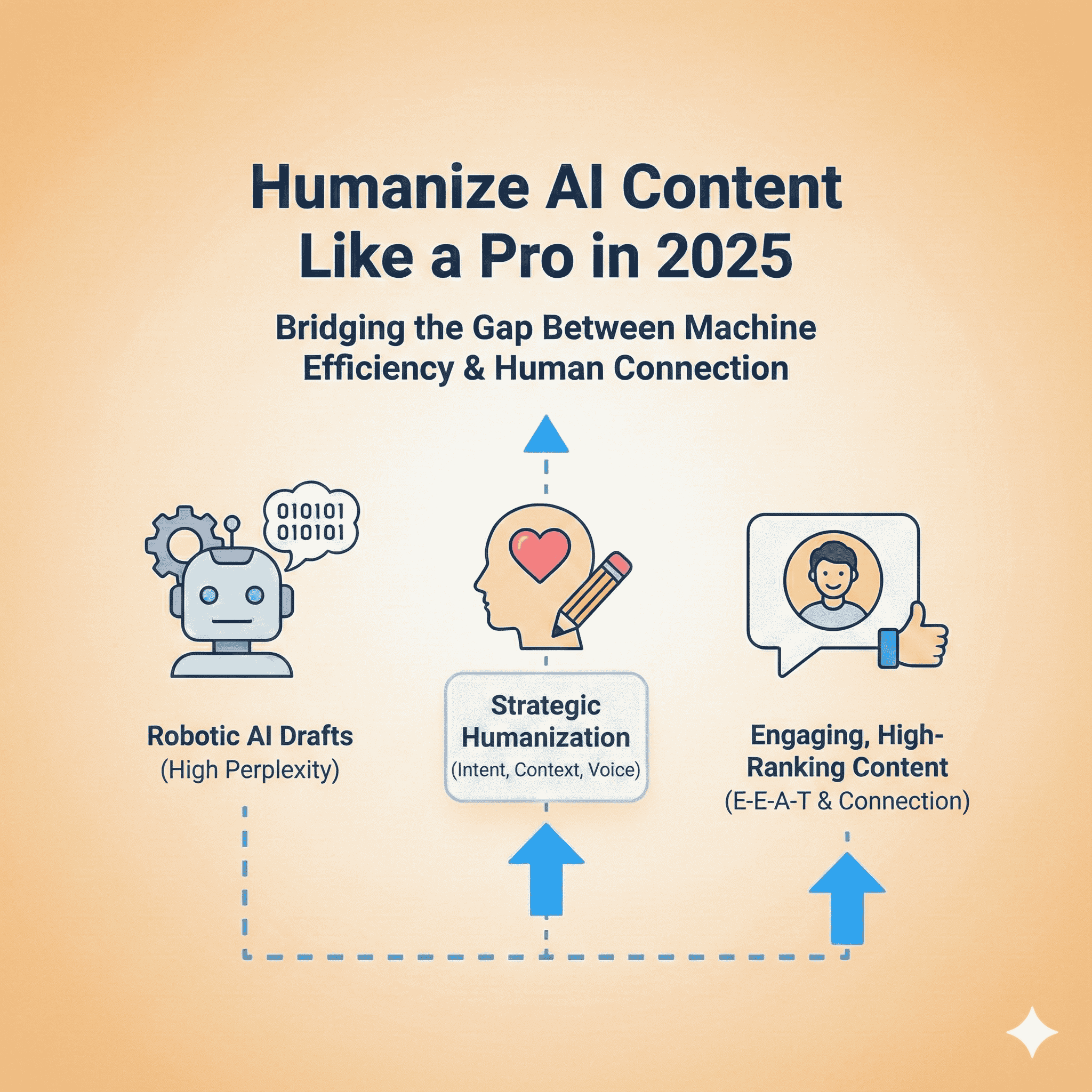
True humanization is about injecting intent, context, and voice. It is the process of taking the raw information provided by the AI and filtering it through a specific perspective.
To make AI text sound human, you must add:
- Voice: A distinct personality (sarcastic, professional, empathetic).
- Judgment: The ability to say "this is better than that" based on experience.
- Variation: Breaking the predictable rhythm of machine text.
- Empathy: Acknowledging the reader's pain points in a way that feels genuine, not simulated.
How Google and Readers Evaluate AI Content in 2025
The landscape of SEO has shifted. In previous years, the fear was that Google would penalize AI content simply for being AI. In 2025, we know this isn't entirely true. Google penalizes bad content, regardless of who wrote it. However, unedited AI content usually falls into the "bad" category because it lacks E-E-A-T (Experience, Expertise, Authoritativeness, and Trustworthiness).
The Role of AI Content Detection
While Google has stated they focus on quality, third-party AI content detection tools are widely used by publishers, universities, and editors. These tools analyze "burstiness" (sentence variation) and "perplexity" (word choice unpredictability).
If your content triggers high probability scores in these areas, it flags the content as potentially low-effort.
Why Engagement Signals Matter More
More than just AI writing vs human writing detection scripts, Google looks at user behavior. If a user lands on your page, sees a wall of robotic, repetitive text, and bounces immediately back to the search results, your rankings will tank.
Humanizing your content isn't just about vanity; it is a critical SEO survival strategy. You must demonstrate "Experience"—the first "E" in E-E-A-T. AI cannot have experience; only you can. Therefore, humanizing implies adding that layer of personal expertise that the machine cannot replicate.
Step-by-Step Process to Humanize AI Content (Pro Method)
If you want to know how to humanize AI content effectively, you need a workflow. Randomly changing words won't cut it. Follow this five-step protocol to transform robotic drafts into engaging, high-ranking content.
Step 1 – Start With a Clean AI Draft
When you prompt your AI (whether ChatGPT, Claude, or Jasper), aim for structure and information density, not final prose. Ask the AI to create a detailed outline or a "rough draft."
Do not try to humanize ChatGPT text while it is generating. Let the AI do what it does best: data aggregation and structuring. Once you have the text, copy it into a separate document. This mental separation—between "generation mode" and "editing mode"—is crucial.
Step 2 – Rewrite the Opening in Human Language
The first 50 words are the most dangerous. AI models almost always start with generic "hooks" like "In today's fast-paced digital world..." or "X is an important aspect of Y..."
This is an immediate signal to the reader that the text is machine-generated. To make AI text sound human, delete the AI's intro entirely. Write the opening hook yourself. Use:
- A personal anecdote.
- A startling statistic without generic fluff.
- A direct address to the reader's specific problem.
By manually writing the intro, you set the "voice" for the rest of the piece.
Step 3 – Add Context, Judgment, and Explanation
Now, look at the body paragraphs. The AI has likely provided facts. Your job is to provide context.
- Add "I think": Where the AI lists three options, add a sentence recommending one over the others and explain why.
- Use analogies: AI is bad at metaphors. Humans explain complex topics by comparing them to everyday things.
- Cite specific examples: AI might say "marketing is effective." A human says, "Take the 2024 Nike campaign, for example..."
This is the core of humanization—adding the "why" to the AI's "what."
Step 4 – Use an AI Humanizer Tool (When & Why)
Sometimes, the volume of content is too high for deep manual editing, or the AI text is so stiff that rewriting it feels like a chore. This is where an AI humanizer tool or an AI to human text converter becomes a vital part of the workflow.
These tools are designed to rewrite text specifically to alter the perplexity and burstiness patterns that detectors look for. They break up the symmetrical sentence structures automatically.
For example, tools like aitohumantextconverter.io are built to rephrase robotic text into more natural, flowing language. Using a tool like this can do 80% of the heavy lifting, stripping away the "machine" syntax so you can focus on the final polish. It acts as a bridge, ensuring the text flows naturally before you add your final expert touches.
Step 5 – Final Human Edit and Read-Through
Never publish the output of a converter raw. The final step is the "Breath Test." Read the content aloud.
- If you run out of breath because a sentence is too long, cut it.
- If you stumble over a clumsy phrase, fix it.
- If it sounds too formal, add a contraction (change "do not" to "don't").
This final pass ensures the rhythm matches natural speech, which is the ultimate goal of humanization.
Manual Editing vs AI Humanizer Tools
There is often a debate in the content community: should you edit manually, or use an AI humanizer tool? The answer depends on your goals and volume.
Manual Editing
- Pros: unparalleled quality, unique brand voice, zero cost.
- Cons: Extremely time-consuming, difficult to scale.
- Best for: Thought leadership pieces, homepage copy, and high-stakes emails.
AI Humanizer Tools (AI to Human Text Converter)
- Pros: Speed, consistency, and the ability to bypass AI detection naturally by algorithmically altering sentence patterns.
- Cons: Can sometimes alter meaning if not monitored.
- Best for: Bulk blog posts, academic summaries, technical documentation, and Tier 2 SEO pages.
The Hybrid Approach
The most effective strategy in 2025 is the hybrid approach. Use an AI to human text converter to handle the structural rewriting, and then spend 10 minutes adding your specific insights (Manual Step 3). This gives you the best of both worlds: the speed of AI and the quality of human writing.
Common Mistakes to Avoid When Humanizing AI Content
In the rush to bypass AI detection naturally, many creators make errors that hurt their content's readability.
1. Over-Randomization
Some users try to trick detectors by inserting random words or weird syntax. While this might confuse a detector, it also confuses your reader. If the text is unreadable, it fails its primary purpose.
2. Keyword Stuffing
When trying to optimize, don't force keywords like humanize AI content in 2025 into every sentence. Google’s NPL (Natural Language Processing) is smart enough to understand context. Focus on flow first.
3. Blind Detector Chasing
Do not obsess over getting a "100% Human" score on every single detection tool. These tools yield false positives. If you have manually edited the content and it reads well, trust your judgment over the tool's percentage.
When You Should Use an AI to Human Text Converter
There are specific scenarios where using a dedicated AI to human text converter is the smartest move:
- Academic Research & Essays: When you are using AI to brainstorm or outline ideas, a converter helps ensure the final phrasing is unique and distinct, avoiding unintentional plagiarism flags.
- High-Volume SEO Blogging: If you need to publish 50 articles a month, manual editing is impossible. A converter streamlines the process.
- Business Emails: To ensure your automated or AI-drafted emails don't sound cold to clients, running them through a humanizer can warm up the tone instantly.
- Marketing Copy: Ad copy needs to sound punchy and emotional—areas where raw AI often fails but humanizers excel.
FAQs
How do you humanize AI content in 2025?
To humanize AI content, focus on disrupting the predictable patterns of AI text. Use personal anecdotes, vary sentence length, add strong opinions, and use natural, conversational language. A combination of manual editing and humanization tools works best.
Can humanized AI content rank on Google?
Yes. Google does not penalize content for being AI-generated; it penalizes low-quality content. If you humanize the content to provide value, engagement, and clear expertise (E-E-A-T), it can rank just as well as human-written text.
Do AI humanizers really work?
Yes, high-quality AI humanizer tools work by restructuring the syntax and vocabulary of the text to increase "perplexity" and "burstiness." This mimics human writing patterns and makes the text sound more natural while bypassing detection filters.
Is AI detection always accurate?
No. AI detection is probabilistic, not definitive. False positives (where human text is flagged as AI) and false negatives are common. They should be used as a guide, not an absolute truth.
Is using an AI to human text converter safe?
Yes, it is safe as long as you review the final output. These tools are text processors. However, always ensure the factual accuracy of the content remains intact after conversion.
Conclusion
Learning how to humanize AI content is no longer an optional skill—it is a requirement for digital communication in 2025. As AI tools become more prevalent, the value of the "human touch" only increases.
We are not trying to hide the fact that we use AI; we are trying to bridge the gap between machine efficiency and human connection. Whether you choose to edit meticulously by hand or utilize tools like aitohumantextconverter.io to speed up the process, the goal remains the same: to create content that serves the reader.
Don't settle for the "grey goo" of raw AI drafts. inject your voice, add your experience, and take control of your content strategy today.